


Why Do I Replay Conversations in My Head?
For mental replays, unfinished conversations, imagined responses and the feeling that the mind keeps returning to what was said, not said or misunderstood.
You review your answer.
You imagine what you should have said differently.
You wonder if your tone sounded wrong.
You think about what they really meant.
You create another version of the conversation where you are clearer, stronger, calmer or more respected.And then another version.And then another.At some point, the conversation is no longer happening between two people.It is happening inside you.
Quick Answer
You may replay conversations in your head because something about the exchange feels unfinished.
The mind may be trying to understand what happened, repair what was said, restore dignity, find closure, separate your responsibility from the other person’s reaction, or recover a clearer sense of self-respect.
This does not mean something is wrong with you. It means the conversation may have touched an unresolved inner point.
The replay continues because the mind is still trying to complete something.
Why do I replay conversations in my head?
A conversation can continue in the mind when something about it feels incomplete.
Maybe you did not say what you really wanted to say.
Maybe you felt misunderstood.
Maybe you left the situation without clarity.
Maybe the other person’s tone stayed with you.
Maybe you sensed judgment, rejection, pressure or disrespect.
Maybe you are trying to understand whether you did something wrong.
The mind often replays a conversation when it is still trying to complete something internally.
It may be trying to find the right words.
It may be trying to protect your image.
It may be trying to restore a sense of control.
It may be trying to understand the other person.
It may be trying to recover dignity after a moment where you felt exposed, dismissed or uncertain.
From the outside, this may look like overthinking.
From the inside, it often feels like an attempt to repair something.
The mind repeats what feels unfinished
The mind does not usually replay a conversation for no reason.
It repeats what still feels unresolved.
Sometimes the unresolved point is obvious.
You may know exactly what you wish you had said.
At other times, the unfinished point is more subtle.
You may not be replaying the words themselves.
You may be replaying the feeling the conversation left inside you.
A sentence may have stayed with you.
A look.
A tone.
A pause.
A change in someone’s expression.
A moment where you felt you lost your place.
A moment where you were not able to say what was true.
That is why the replay can feel stronger than the actual conversation.
The event passed.
But the inner position created by the event has not fully settled.
The conversation may be over, but your inner position is not settled
A mental replay is not always about the conversation itself.
Sometimes it is about the position you were left in.
You may have left the conversation feeling smaller than you wanted to feel.
Or confused.
Or guilty.
Or unseen.
Or defensive.
Or responsible for something that was not fully yours.
Or uncertain about what the other person now thinks of you.
When the inner position remains unsettled, the mind keeps returning to the scene.
It is not only asking:
“What happened?”
It may also be asking:
“Who was I in that moment?”
“Did I lose my place?”
“Was I clear?”
“Was I respected?”
“Did I betray myself?”
“Did I say too much?”
“Did I say too little?”
“What does this mean about me?”
This is why some conversations continue internally long after they ended externally.
The conversation ended in time.
But it may not have ended inside your perception.
Mental replay vs. useful reflection
There is a difference between reflecting on a conversation and replaying it.
Reflection brings more clarity.
Replaying often brings more tension.
Reflection helps you see what happened.
Replaying keeps you inside the scene.
Reflection may lead to a decision, apology, boundary, new conversation or release.
Replaying tends to repeat the same mental material without creating a real next step.
Is this thought helping me understand, or is it keeping me inside the same scene?
If the thought creates more clarity, it may be reflection.
If it creates more pressure, self-attack, imagined arguments or emotional exhaustion, it may be a repeating thought pattern.
Common signs of replaying conversations
You may be replaying a conversation in your head when:
- you keep hearing the same sentence again;
- you imagine what you should have said;
- you create alternative versions of the conversation;
- you try to guess what the other person really meant;
- you worry about how you were perceived;
- you feel the need to prove your point internally;
- you keep defending yourself in your mind;
- you feel tension in the body when the memory returns;
- you cannot let the scene become complete;
- you keep trying to find the “perfect answer” after the moment has passed.
The pattern is not only mental.
It often has a felt quality.
You may notice tightness, heaviness, irritation, embarrassment, heat, contraction or restlessness when the replay begins.
That felt quality matters.
It shows that the mind is not just reviewing information.
It is reacting to an internal charge.
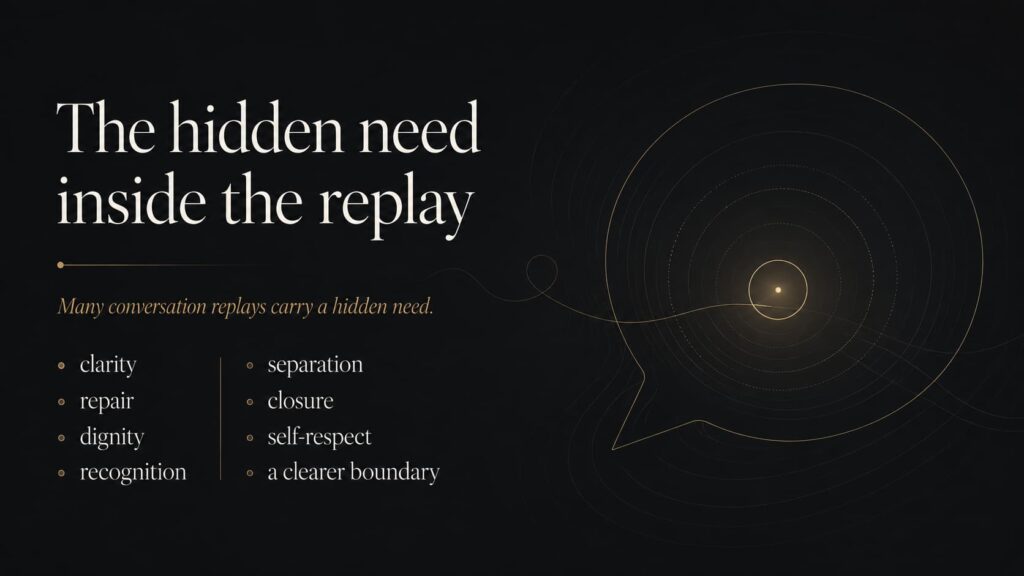
The hidden need inside the replay
Many conversation replays carry a hidden need.
The need may be for clarity.
Or repair.
Or dignity.
Or recognition.
Or separation.
Or closure.
Or self-respect.
Or a clearer boundary.
The replay becomes more useful when you stop treating it as random noise and begin to notice what it may be trying to complete.
| Hidden need | What the mind may be trying to complete |
|---|---|
| Clarity | “What really happened?” |
| Repair | “Should I correct, explain or apologize?” |
| Dignity | “Did I lose my position?” |
| Recognition | “Was I seen, heard or understood?” |
| Separation | “What is mine and what belongs to them?” |
| Closure | “Can this be complete now?” |
| Self-respect | “Did I betray myself?” |
| Boundary | “What needs to be clearer next time?” |
This is important.
Because when the replay is reduced to “I am overthinking,” the deeper signal is missed.
The mind may not be asking you to think more.
It may be asking you to recognize what was affected.
Was it your confidence?
Your sense of value?
Your need to be understood?
Your ability to say no?
Your fear of disappointing someone?
Your fear of being judged?
Your difficulty separating what belongs to you from what belongs to the other person?
A conversation replay is often not only about the words exchanged.
It may be about the inner position those words activated.
Why imagined responses do not always bring closure
One reason mental replays become exhausting is that the mind tries to win a conversation that is no longer happening.
It creates a better answer.
A sharper answer.
A calmer answer.
A more intelligent answer.
A more dignified answer.
But the imagined correction does not always resolve the internal charge.
Sometimes it strengthens it.
Because every new imagined version brings you back into the same scene.
You may feel briefly satisfied when you find the perfect sentence.
Then the mind asks for another version.
Another defense.
Another explanation.
Another imagined outcome.
This is how a conversation becomes an inner loop.
The mind keeps trying to repair the past through mental editing.
But the past is not being edited.
It is being repeated.
What part of the conversation belongs to you?
When a conversation keeps replaying, one of the most useful first distinctions is this:
What part of this belongs to me, and what part belongs to the other person?
Not everything that happened in the conversation is yours to carry.
Your words may belong to you.
Your tone may belong to you.
Your intention may belong to you.
Your clarity or lack of clarity may belong to you.
But the other person’s interpretation does not fully belong to you.
Their projection does not fully belong to you.
Their mood does not fully belong to you.
Their reaction does not fully belong to you.
Their unresolved history does not belong to you.
Their inability to understand you may not belong to you.
A replay often becomes heavier when you carry both sides of the conversation inside yourself.
You become yourself.
Then you become the other person.
Then you become the judge of both.
That is too much internal weight for one conversation.
A simple way to recognize the replay
Before trying to force the replay away, pause and name it accurately.
You might say internally:
“This is a mental replay.”
“This is an unfinished inner conversation.”
“My mind is returning to what was said.”
“I am trying to complete something inside.”
“I do not need to solve both sides of the conversation right now.”
Then ask:
What feels unfinished here?
Do not rush the answer.
The answer may be:
- “I wanted to be understood.”
- “I did not speak clearly.”
- “I felt judged.”
- “I felt smaller than I wanted to feel.”
- “I need to separate what is mine from what is not mine.”
- “I may need a real conversation, not an imagined one.”
- “I need to let this end.”
- “I need to return to myself.”
This is not the full Possibility Field method.
It is only a beginning point for recognition.
The goal is not to solve the entire pattern in one moment.
The goal is to stop being completely absorbed by the replay and begin recognizing what is active.
When you may need a real next step
Sometimes the replay points to something practical.
Maybe you need to clarify something with the person.
Maybe you need to apologize.
Maybe you need to set a boundary.
Maybe you need to stop explaining yourself to someone who is not willing to understand.
Maybe you need to write the facts down once and stop mentally rewriting them.
Maybe you need to accept that the other person’s reaction belongs to them.
Maybe you need to recognize that the conversation is complete, even if it was imperfect.
Not every replay requires another conversation.
But every replay asks for recognition.
Without recognition, the mind keeps returning to the same inner material.
The conversation you are replaying may not be the real conversation
Sometimes the conversation in your head is not only about the person in front of you.
It may be connected to older patterns.
Moments when you felt unheard.
Times when you were not allowed to speak.
Situations where you had to explain yourself too much.
Relationships where your intention was misunderstood.
Experiences where silence felt safer than truth.
This does not mean every conversation replay is deep or dramatic.
But it does mean that the mind may be reacting to more than the surface event.
A small sentence can activate a larger pattern.
A tone can activate an old position.
A look can activate a familiar fear.
A simple disagreement can activate the need to defend your value.
This is why some conversations stay in the mind longer than expected.
They touched something that was already sensitive.
What to remember
You do not replay conversations because you are broken.
You replay them because something inside has not yet found a clear place.
The replay may be trying to complete a sentence, restore dignity, understand the other person, protect your image, separate responsibility or recover your own position.
But thinking more is not always the same as seeing clearly.
At some point, the mind does not need another version of the conversation.
It needs a clearer relationship with what happened.
Field Reflection
Ask yourself:
What part of this conversation am I still carrying?
Then ask:
Is this mine to understand, mine to repair, mine to release, or not mine to carry?
Do not use the question to attack yourself. Use it to separate what is present.
Possibility Note
A conversation does not need to become an inner room you keep living inside.
You can learn from what happened without continuing to replay it.
Next Movement
Choose one small movement.
Write one sentence that names what feels unfinished.
- “I felt misunderstood.”
- “I wanted to explain myself better.”
- “I am carrying the other person’s reaction.”
- “I need to clarify something.”
- “I need to stop holding both sides of this conversation.”
Then pause.
Do not write the whole argument. Do not rewrite the conversation. Just name the unfinished point.
Recognition begins when the loop receives a clearer name.
When the conversation keeps coming back
If you keep replaying conversations in your head, the pattern may need more than one insight.
An article can help you recognize what is happening.
A focused guide can help you look at the pattern more clearly.
A deeper practice can help you approach recurring inner patterns with more structure.
Possibility Field begins with this kind of recognition: noticing what is active, naming the pattern, and choosing the next step with more clarity.
The first movement is not to win the conversation in your head.
The first movement is to recognize why the conversation is still living there.
Frequently Asked Questions
Why do I keep replaying conversations in my head?
You may keep replaying conversations because the mind is trying to complete something that feels unresolved. The replay may point to a need for clarity, repair, recognition, closure, self-respect, separation or a clearer boundary.
Is replaying conversations a form of overthinking?
It can be. Replaying becomes overthinking when the mind repeats the same scene without creating new clarity, a real decision or a coherent next step.
Why do I imagine what I should have said?
You may imagine what you should have said because part of you is trying to restore clarity, dignity or control after a moment that felt incomplete, misunderstood or emotionally charged.
How do I stop replaying a conversation?
A first step is to stop fighting the replay and name it accurately: “This is a mental replay.” Then ask what feels unfinished and whether the next step is clarification, release, a boundary or no action.
What does it mean when a conversation stays in my mind?
It may mean the conversation touched something that was already sensitive: being misunderstood, judged, dismissed, exposed, responsible, rejected or unclear about your own position.
Should I talk to the person again?
Sometimes. If the replay points to a real need for clarification, repair or boundary, another conversation may be useful. But if the replay is only creating imagined arguments, the first step may be to recognize what is unfinished inside before taking action.
Is it normal to replay conversations after social situations?
Yes, many people mentally review conversations after social situations. It becomes more significant when the replay creates tension, self-criticism, emotional exhaustion or keeps returning without new clarity.
Repeating Thoughts
Repeating Thoughts
Still replaying the conversation?
Use the free reflection guide to identify what feels unfinished and which inner pattern may be active right now.